How Sand Battery Went from a Balcony Experiment to Commercial Deployment
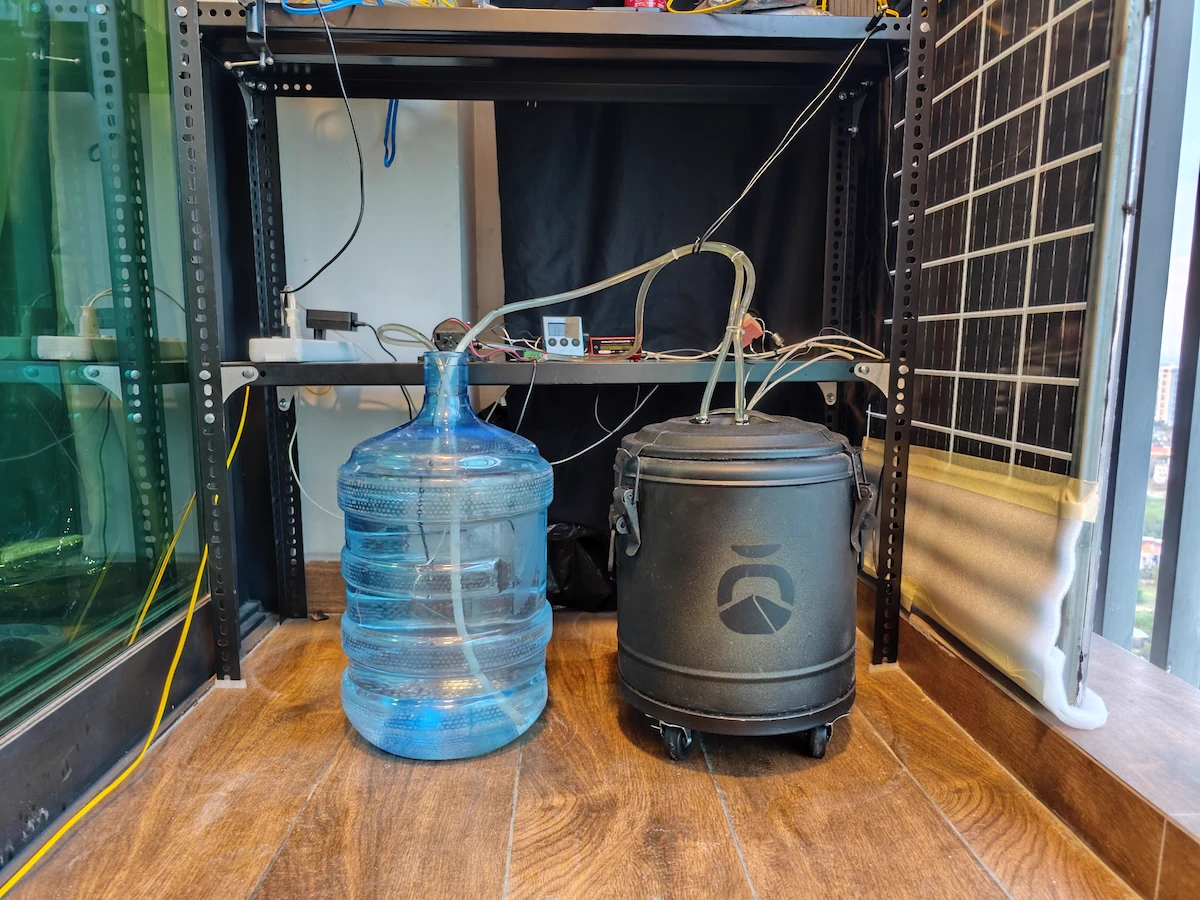
Most people see a climate-tech company after the press release, after the polished demo, after the first customer photo.
That is not how the sand battery story started.
It started as a small experiment, the kind of thing you do when you are trying to learn a new physical domain without pretending you understand it yet. The original goal was not a grand market thesis. It was closer to a stubborn technical curiosity: can heat be stored in a way that is cheap enough, simple enough, and robust enough to matter in the real world?
That question ended up changing everything.
The first stage was not glamorous
At the beginning, there was no factory, no mature supply chain, no long strategic slide deck.
There was a mini-lab mentality. A balcony. A temporary garage. A lot of trial and error. And a willingness to treat a messy prototype as a real learning system instead of a failure.
That matters because physical products do not reward wishful thinking. Software can survive a surprising amount of abstraction. Heat does not. Materials, insulation, control, safety, and assembly all have to line up or the idea stays theoretical.
So the work became less about "having a cool concept" and more about answering practical questions:
- What should the thermal medium be?
- How do you retain heat long enough for it to be useful?
- How do you discharge it in a controlled way?
- Can the system be built with materials people can actually afford?
- Does this help a real customer, or only impress other founders?
The answer to that last question is the one that mattered most.
A prototype is only useful when it meets a use case
The sand battery became interesting once it stopped being a science experiment and started looking like a solution.
In the early days, the team kept coming back to the same real-world patterns: agricultural drying, process heat, and off-grid or weak-grid environments where energy is expensive, inconsistent, or both. Those are not vanity use cases. They are the places where heat is a direct operating cost.
That is why thermal storage is such an underappreciated category. A lot of businesses do not actually need electricity in the abstract. They need heat, for long periods, at a predictable cost. If you can store heat well, you can move the energy burden away from peak demand and into a more manageable window.
That is the strategic value of a sand battery.
It is not just about "saving energy" in a broad sense. It is about giving operators a different way to think about heat supply, cost structure, and reliability.
The first year changed the shape of the company
By early 2024, the project had already moved far beyond the original balcony-stage curiosity.
The team had gone through the usual sequence every deep-tech founder eventually faces:
- build something crude,
- prove it can work,
- move locations,
- rebuild the lab,
- keep researching,
- keep fundraising,
- and keep pushing even when the environment changes around you.
That sounds simple when written as a list. In reality, it is a lot of pressure packed into a short period of time.
The biggest lesson from that period was that the product and the company are not separate. The design choices, the lab moves, the hiring decisions, the customer conversations, and the fundraise all shape each other. If one layer is weak, the others suffer.
That is why I do not think of the first year as a "startup milestone" in the superficial sense. It was a systems-building year.
First commercial delivery
One of the clearest signals that the idea had crossed from aspiration into reality was the first commercial delivery of the sand battery to Ecovi in Nha Trang.
That moment matters because it forces a different standard.
Once a product reaches a customer, it is no longer enough to say the idea is interesting. It must work in the context of someone else's actual operation, with their constraints, their expectations, and their economic reality.
That is the shift from prototype thinking to product thinking.
It also changes the emotional tone of the work. Shipping the first unit is not only validation. It is responsibility. Suddenly the question is no longer "can we build it?" but "can we make this repeatable, supportable, and worth adopting again?"
For a hard-tech startup, that is the real inflection point.
Why the NUS ecosystem mattered
The sand battery story is also an ecosystem story.
In January 2024, the team welcomed NUS Enterprise delegates to the lab. That visit was more than a ceremonial photo opportunity. It reflected the long arc of relationships that often make deep-tech ventures possible: alumni networks, research culture, support institutions, and people who are willing to look at a strange idea and still take it seriously.
That part of the story is easy to underestimate.
Deep-tech companies rarely grow in isolation. They need:
- access to technical communities,
- practical feedback from domain experts,
- credibility when the product is still immature,
- and enough institutional trust to keep going through the difficult phases.
The NUS ecosystem had already been part of the wider journey for years. Seeing that support come back around in 2024 made the story feel less like a solo experiment and more like something that had been incubating inside a network for a long time.
External validation is useful, but it is not the point
When e27 featured the sand battery, it was a nice signal.
It meant the work was being noticed beyond our own circle. It also reinforced the obvious truth that thermal energy storage is still an underbuilt frontier, especially compared with the attention given to AI. The climate-tech opportunity is still enormous because the engineering gap is still huge.
But I do not trust validation as the north star.
Media attention can be useful. Awards can be useful. Investor attention can be useful. None of them solve the engineering problem. None of them manufacture customer fit. None of them make the materials cheaper or the controls better.
The real question remains simple: does the system help people do useful work with less waste and more reliability?
If the answer is yes, then the recognition matters. If the answer is no, then the recognition is just noise.
What I learned from the journey so far
There are a few things I now believe more strongly than I did when the project was still just an idea:
- Physical products require patience that software founders often underestimate.
- A good prototype is not the same as a good business, but it is the only honest starting point.
- The right ecosystem can reduce the cost of persistence.
- First customers change the conversation more than any pitch deck can.
- In energy and climate tech, practicality always beats fantasy.
The other thing I learned is that the product only becomes meaningful when the story moves from abstract possibility to actual deployment. A balcony experiment is interesting. A working prototype is better. A delivered system to a real customer is a different class of event.
That is when the work becomes a business, not just a build.
Why this is still early
Even with the first delivery and the early recognition, I would still call this stage early.
The market is large, the engineering problems are real, and the work ahead is still substantial. There are more versions to build, more use cases to test, more customers to serve, and more system-level improvements to make.
That is exactly why I like the category.
The opportunity is not to make a flashy science project. The opportunity is to make thermal energy storage practical enough that teams in agriculture, industry, and infrastructure actually want to use it.
That is a much harder goal. It is also the right one.
Closing thought
If I had to reduce the whole story to one line, it would be this:
Sand battery started as a small experiment, but it only became real when it survived the messy parts of building, shipped to a customer, and kept attracting the right people around it.
That is the stage I care about now.
Not the myth of invention. The discipline of making something useful enough that it can keep going.