The Alterno Lawsuit Timeline: Corporate Restructuring and Document Discrepancies (SAND - Part 19)
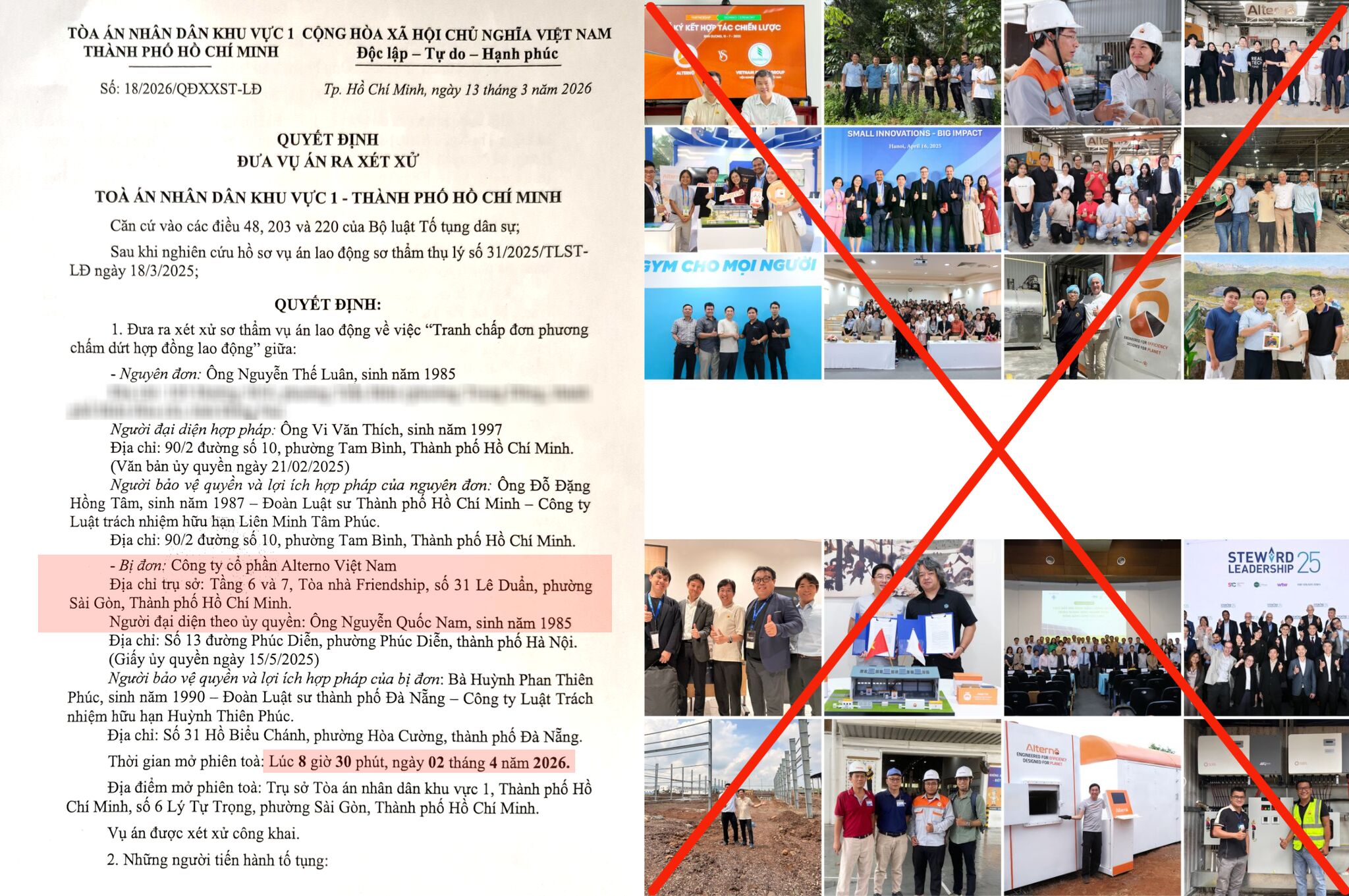
To understand the sequence of events between myself and the management team at Alterno (Hai Ho and Nam Nguyen) from March to June 2025, one must examine the documented timeline of court filings, corporate restructuring records, and official government correspondence.
The public relations narratives previously released by Alterno present one perspective. However, the concrete timeline of legal actions and official company filings reveals significant discrepancies that require a closer, evidence-based review. Here is a chronological timeline of those events.
March 2025: Court Summons and Financial Obligations
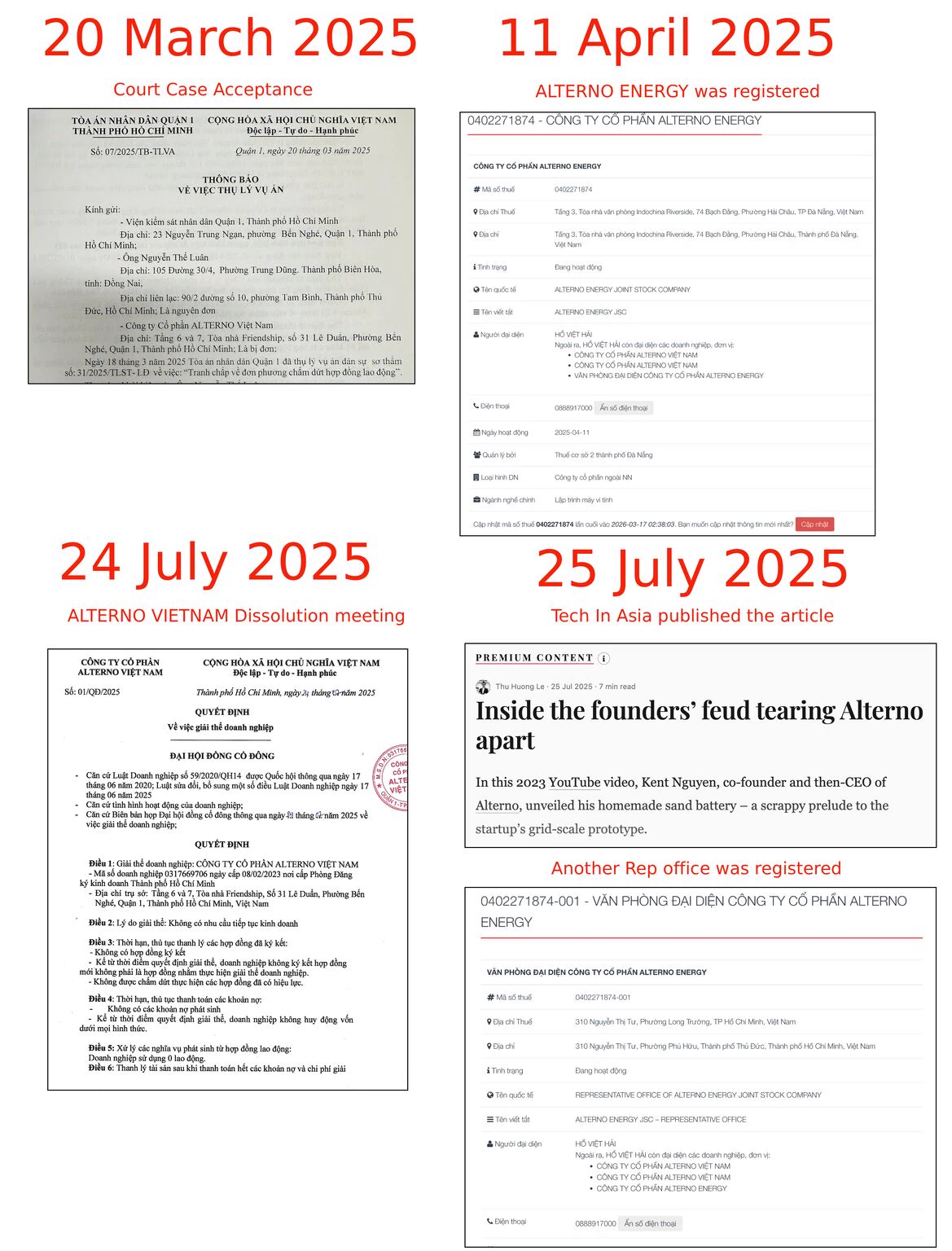
On March 19, 2025, a formal mediation session regarding my wrongful termination was held with the relevant labor authorities. According to the records, the Alterno representative declined to sign the official mediation document. The following day, on March 20, the Vietnamese court formally accepted my wrongful termination case for investigation.
Meanwhile, a separate financial obligation was due on March 31, 2025: a $50,000 installment related to our Singapore Share Transfer Contract. Alterno's management refused the payment, citing an ambiguous claim of a "breach of confidentiality." Rather than fulfilling the contractual term, they proposed delaying the payment completely until June 2026.
April 2025: Delayed Appearance and Corporate Restructuring
As the initial April 15 court date approached for the wrongful termination hearing, the timeline of corporate filings became particularly noteworthy. On April 10, Hai Ho submitted a formal letter to the court requesting a delay to the proceedings, without proposing an alternative date.
The very next day, on April 11, 2025 - four days before the scheduled court appearance - public business registration records show the founders established a completely new legal entity in Da Nang named "Alterno ENERGY." In certain business circles, this pattern of establishing a new, unburdened entity while the original company faces legal and financial obligations is informally referred to as the "golden cicada shedding its shell" (ve sầu thoát xác).
On April 15, representatives for Alterno Vietnam did not appear in court.
May 2025: Patent Timelines and Dissolution Proceedings
The documentation trail in May presented several significant anomalies. On May 1, an email was sent to my Alpha Bits development team from an unauthorized address ([email protected]) claiming to be me. The email contained severe insults directed at my team ("I challenge your entire 18 generations of ancestors"). The origin of this email coincided with the ongoing dispute.
In court, on May 15, Alterno submitted a written defense. Their primary legal foundation for my termination rested on a "Labor Regulation" document, which the submission claimed was signed on August 1, 2024.
Shortly after this submission, on May 21, I examined intellectual property records and discovered that the USPTO patent for the Sand Battery technology - the foundational IP of the company - had actually been approved back in October 2024. This significant corporate asset approval had not been communicated to me for seven months during the period my exit was being negotiated.
Following this discovery, on May 23, internal documents and disparaging comments were circulated by Hai Ho in a private chat group consisting of former Antler members. Exposing private contractual details to external parties during an active legal dispute is highly irregular.
The culmination of this timeline occurred on May 24, 2025, when the board passed a formal resolution to dissolve the original entity, Alterno Vietnam JSC. The stated reason for dissolution was "no need to continue business operations" (Không có nhu cầu tiếp tục kinh doanh). This initiated the legal closure of the specific corporate entity that was currently subject to the wrongful termination lawsuit.
June 2025: Contradictory Statements and Official Confirmations
By early June, Alterno shifted focus to public relations, publishing a statement asserting that a "structured and fully documented separation was agreed upon." They definitively declared to the public and their investors that "There are no ongoing legal proceedings against Alternō or its stakeholders," categorizing the ongoing dispute as "unfounded accusations and misinformation."
However, official government records directly contradicted the core premise of their court defense. On June 6, 2025, the Ho Chi Minh City Department of Home Affairs officially confirmed that Alterno Vietnam JSC had never submitted a labor regulation registration dossier since the company’s inception.
Because no registered labor rules legally existed at the government level, the "Labor Regulation" document submitted to the court on May 15, 2025, appears to lack the necessary legal validation required by Vietnamese labor law to execute a disciplinary termination.
Reviewing these dates and documents reveals a pattern of utilizing new corporate entities, undisclosed patents, contradictory HR documents, and firm PR statements while a lawsuit is actively ongoing.
When the timeline is read in strict chronological order, the sequence looks less like a clean separation and more like a series of overlapping corporate moves layered over unresolved disputes. As we will see in SAND Part 20 and SAND Part 21, this domestic corporate restructuring attempt ("ve sầu thoát xác") was merely the first phase of a broader strategy: routing assets into offshore shell entities and pivoting toward unregulated retail crypto pools once traditional VC due diligence stalled.
The public narrative improved with time, but the underlying document trail did not.
For a complete, interactive day-by-day record of these events, you can view the full Sand Battery timeline.