Sand Battery vs Lithium Battery: Cost, Lifespan, and Thermal Storage Tradeoffs (SAND - Part 5)
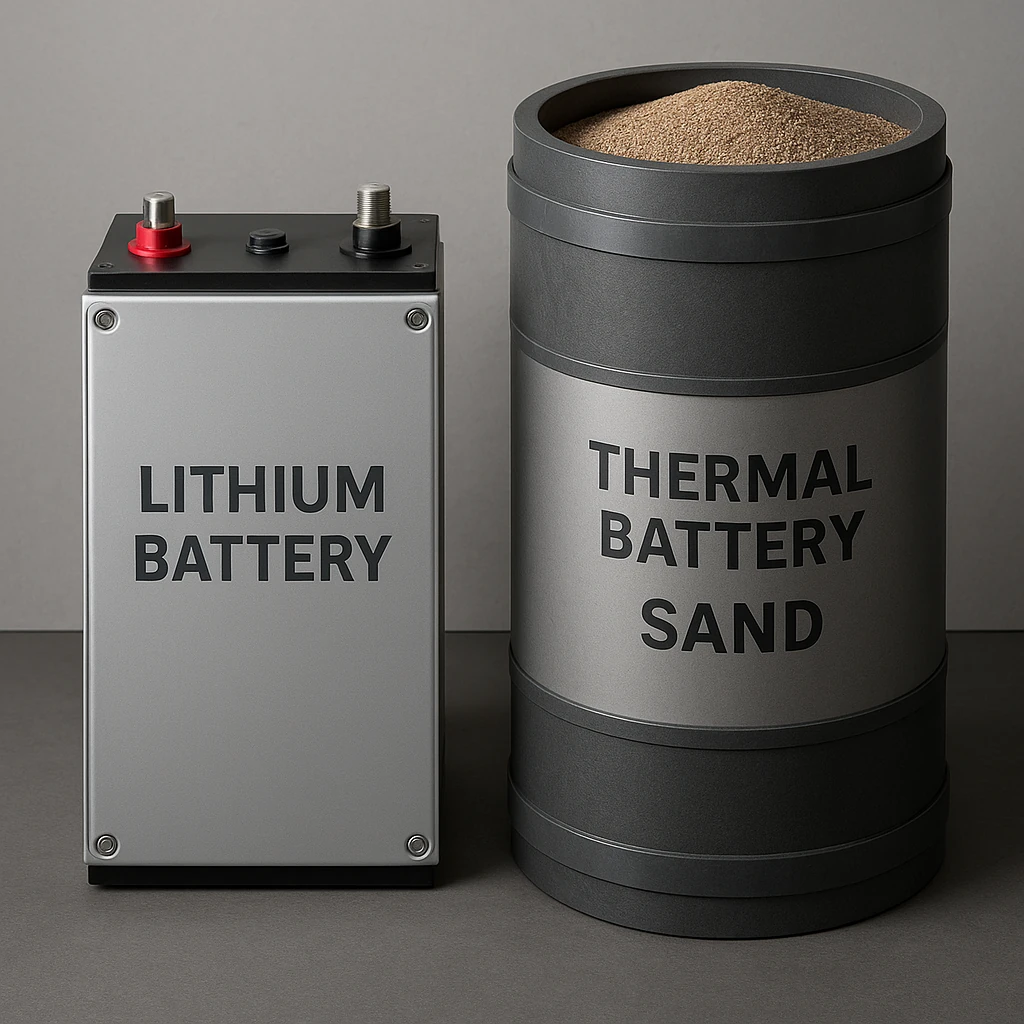
Building on the residential use case for a Da Lat homestay in Part 4, this part compares the detailed Capital Expenditure (CAPEX) and Operational Expenditure (OPEX) of a 250 kWh Sand Battery costing ~$20,000 USD against a Lithium Battery of the same capacity.
We’ll design a simple setup with a full solar array to back up both systems, then evaluate multiple factors: cost, efficiency, lifespan, maintenance, and environmental impact. Let’s break it down!
System Setup: Sand Battery vs. Lithium Battery with Solar Backup
Both systems are designed to store 250 kWh of energy, powered by a solar array tailored to meet charging needs in a location like Da Lat, Vietnam (4 peak sun hours daily). The setup assumes a mid-sized industrial or community application, off-grid, with zero-emission goals.
- Solar Array: A 75 kWp solar array (150 panels at 500 W each) generates ~300 kWh/day (75 kW × 4 hours), sufficient to charge 250 kWh daily with a 20% buffer for losses, aligning with the Sand Battery’s 98% charging efficiency and Lithium Battery’s typical 95% efficiency.
- Sand Battery (250 kWh, $20,000): A scaled-up version of the 20 kWh unit (Part 4), using ~2.5 tons of sand, heated to 600°C, with a 200 cm × 200 cm × 250 cm container, insulated to limit 5–10% daily heat loss.
- Lithium Battery (250 kWh, Market-Estimated): A Lithium Iron Phosphate (LFP) system, common for stationary storage, with a capacity of 250 kWh, costing ~$250,000 based on recent market trends (assuming ~$1,000/kWh).
CAPEX Comparison
- Sand Battery CAPEX:
- Battery Cost: $20,000 for 250 kWh.
- Solar Array: $75,000 (75 kW × $1,000/kW).
- Installation & Piping: $10,000 (scaled from Part 4’s $1,000 for 200 kg unit).
- Total CAPEX: $105,000.
- Lithium Battery CAPEX:
- Battery Cost: $250,000 for 250 kWh ($1,000/kWh, based on current LFP market pricing).
- Solar Array: $75,000 (same 75 kWp array).
- Installation & Inverter: $20,000 (higher due to complex electronics and safety systems).
- Total CAPEX: $345,000.
- Insight: The Sand Battery’s CAPEX is ~30% of the Lithium Battery’s, driven by its low material cost (sand vs. lithium) and simpler infrastructure.
OPEX Comparison
- Sand Battery OPEX:
- Maintenance: Annual cleaning and fan checks (~$100/year), battery replacement negligible (20+ year lifespan).
- Heat Loss: 5–10% daily (12.5–25 kWh/day), offset by solar, no fuel cost.
- Total Annual OPEX: ~$150/year (maintenance + minor upgrades).
- Lithium Battery OPEX:
- Maintenance: Annual checks, cooling system upkeep (~$1,000/year).
- Degradation: 4–5% capacity loss/year (industry data), requiring augmentation after 10–15 years (~$125,000 for 50% replacement).
- Total Annual OPEX: ~$8,500/year (maintenance + $12,500 amortized augmentation over 15 years).
- Insight: Sand Battery OPEX is ~2% of Lithium Battery’s, as it avoids degradation and complex upkeep.
Efficiency and Performance
- Sand Battery:
- Charging Efficiency: 98%.
- Extraction Efficiency: 90%.
- Cycle Life: 20,000+ cycles (theoretical, could be more).
- Drawback: Slower discharge (hours), suited for steady hot water or heating loads.
- Lithium Battery:
- Charging Efficiency: 95%.
- Discharge Efficiency: 90–95%.
- Cycle Life: 5,000–10,000 cycles (typical LFP warranty terms).
- Drawback: Faster degradation, requiring eventual replacement.
- Insight: Lithium offers faster response for peak loads, but Sand Battery’s efficiency and longevity excel for continuous use.
Lifespan and Replacement
- Sand Battery: 20–30 years (sand and container durability), no replacement needed.
- Lithium Battery: 10–15 years (industry data), full replacement at ~$250,000.
- Insight: Sand Battery’s longer lifespan eliminates mid-term costs, while Lithium requires reinvestment.
Environmental Impact
- Sand Battery: Zero operational emissions, 200–500 kg CO2 upfront (manufacturing + construction), negligible over 20 years.
- Lithium Battery: Zero operational emissions, but 3–15 kg CO2/kWh manufacturing (750–3,750 kg CO2 for 250 kWh), plus mining impacts (lithium, cobalt).
- Insight: Sand Battery’s lower embodied carbon and use of abundant sand outshine Lithium’s resource-intensive production.
Summary Table
Factor | Sand Battery (250 kWh) | Lithium Battery (250 kWh) |
|---|---|---|
CAPEX | $105,000 | $345,000 |
Annual OPEX | $150 | $8,500 |
Charging Efficiency | 98% | 95% |
Extraction/Discharge Efficiency | 90% | 90–95% |
Cycle Life | 20,000+ cycles | 5,000–10,000 cycles |
Lifespan | 20–30 years | 10–15 years |
Replacement Cost | $0 | $250,000 |
Embodied Carbon | 200–500 kg CO2 | 750–3,750 kg CO2 |
Best For | Steady thermal loads | Peak power demands |
Final Results
This comparison reveals a clear winner: the Sand Battery dominates with a CAPEX 70% lower, OPEX 98% lower, and a lifespan at least twice as long, making it ideal for continuous thermal applications like the Da Lat homestay or residential heating.
Continue reading Part 6 - Let the real story begin!